
Promoting collaboration
Translational groups
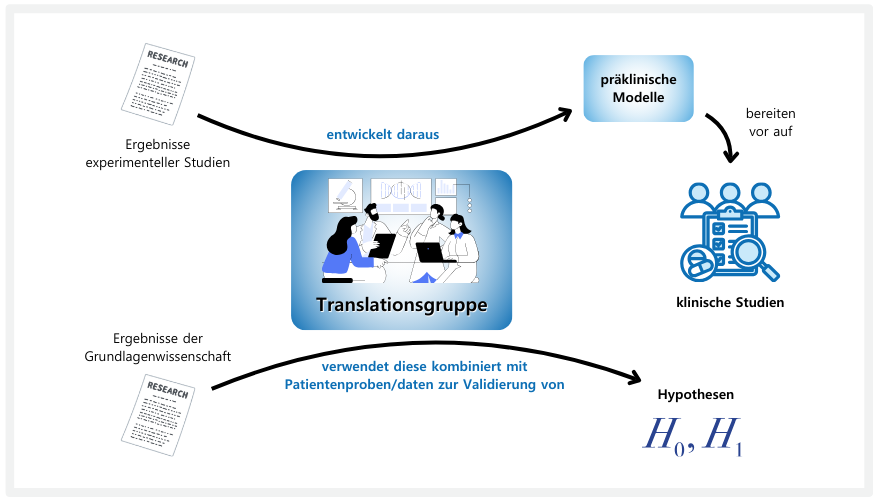
Translational groups are working groups that develop preclinical models from experimental results in order to prepare clinical studies or to validate hypotheses from basic science results using patient samples/patient data.
Reichert translation group
Project title: LEGACY - DeLinEatinG the tumorAl and Clinical evolution of hereditarY pancreatic cancer
Main applicant: Prof. Dr. Maximilian Reichert (TUM Klinikum München)
Participating sites: University Hospital Augsburg, LMU Hospital Munich, University Hospital Regensburg, University Hospital Würzburg
Pancreatic ductal adenocarcinoma (PDAC) is a highly lethal cancer that is usually diagnosed late. The LEGACY project focuses on investigating the clinical and molecular development of hereditary pancreatic cancer (HPC) by studying individuals at high risk of developing PDAC (high-risk individuals, HRI) as well as patients with HPC due to genetic or familial predispositions. LEGACY plans to utilize a data integration system (DIS) already established within the Pancreatic Cancer Alliance Bavaria (PCAB), which will enable the recruitment of HRI and HPC patients and the collection of comprehensive clinical and molecular data. Using this platform, we propose to establish a prospective, BZKF-wide registry of HRIs with detailed longitudinal clinical phenotyping (LEGACYrisk). Within the BZKF network, we will generate a comprehensive collection of HPC samples to perform molecular characterization at the single cell level and spatially resolved to define the cellular and molecular ecosystem of HPC (LEGACYtumor). In addition, we will develop and use advanced patient-derived models such as complex organoid systems to study the mechanisms of disease progression (LEGACYmodel).
The project is uniquely positioned to make significant contributions to the understanding of PDAC due to its comprehensive approach and use of state-of-the-art technology. By integrating clinical data, tissue resources and advanced modeling systems, LEGACY aims to improve the diagnosis and treatment of pancreatic cancer and ultimately lead to better outcomes for patients at risk of this devastating disease.
Translation group Prante
Project title: Translational Radiopharmaceutical Research
Main applicant: Prof. Dr. Olaf Prante (University Hospital Erlangen)
Participating locations: University Hospital Augsburg, FAU Erlangen-Nuremberg, University Hospital Regensburg
The Translational Radiopharmaceutical Research Group (BZKF-TRAFO) aims to make new theranostics available for clinical trials very quickly as predictive and therapeutic markers that are developed in the partners' medicinal chemistry research laboratories. The TRAFO platform is based on existing preclinical developments in the field of new theranostics for breast and pancreatic cancer, develops these further and provides validated procedures for their drug-compliant production. This makes it possible to use the theranostics for patients at the respective BZKF site even before the start of clinical trials. By linking BZKF-TRAFO to the BZKF Theranostics lighthouse, the availability of newly developed theranostics for clinical trials is also to be sustainably strengthened. This involves the chemical optimization of potential theranostics and their evaluation in animal models using preclinical tumor imaging and in therapy studies. BZKF-TRAFO is also developing an innovative biomarker that can visualize the migration of T cells into tumours with the aim of enabling early detection of the response to immunotherapy. The development of new predictive imaging probes for tumor diagnostics and for the prediction of therapy response as well as the successful establishment of their drug-compliant production by BZKF-TRAFO should enable an acceleration of their application and create all the prerequisites for their integration into future clinical studies at the BZKF sites.
Poster Translational Group TRAFO
Translational group Krause
Project title: Determination of residual disease in AML using automated AI-supported analysis of flow cytometry data
Main applicant: Prof. Dr. Stefan Krause, University Hospital Erlangen
Participating sites: University Hospital Augsburg, FAU Erlangen-Nuremberg, LMU Klinikum München, TUM Klinikum München
The assessment of measurable residual disease (MRD) after the start of therapy is of central importance for the prognosis and treatment management of patients with acute myeloid leukemia (AML). In addition to molecular methods, which are only available with sufficient sensitivity for a few changes, flow cytometry (FCM) is used for this purpose. However, this method is not standardized and depends to a large extent on the personal experience of the individual diagnostician. In the proposed project, an "artificial intelligence" (AI)-supported, fully automated pipeline for FCM-based quantification of MRD in AML patients is to be developed, optimized and validated, which works independently of the examiner and should achieve better discriminatory power compared to manual evaluation due to the analysis directly in the n-dimensional space of the data sets. Preliminary work has shown that both the pre-selection of relevant cell populations (i.e. immature cells) and the detection of atypical (i.e. leukemia) cells work in principle. However, several aspects of the methods still need to be optimized and brought together in a pipeline. This would be an important milestone in being able to offer FCM-based MRD diagnostics for all AML patients in a standardized and rapid manner and thus better monitor and control the therapy.
Landwehr translation group
Project title: CAR T Control - Understanding and Addressing Toxicities of CAR T-Cell Therapy
Applicant: Dr. Laura-Sophie Landwehr (University Hospital Würzburg)
Participating sites: University Hospital Augsburg, LMU Clinic Munich
Chimeric antigen receptor (CAR) T cell therapy is an innovative form of immunotherapy in which the body's own T cells are modified in such a way that they direct a specific immune response against tumors. Such therapies have already been approved for hematological neoplasms and are also being tested for solid tumors, among others. An essential prerequisite for the development of effective
therapies is the elucidation of suitable target structures on tumor cells. In order to apply this form of cancer therapy in rare (neuro-)endocrine tumors with a poor prognosis - adrenocortical carcinomas (ACC), pheochromocytomas/paragangliomas (PPGL), neuroendocrine neoplasias (NEN) and radioiodine-refractory thyroid carcinomas (TC) - the highly specialized reference centers for endocrine oncology and cellular immunotherapy at the University Hospitals of Würzburg, Munich and Augsburg will work together. The aim of this research project is to develop one or more optimized cell products for the treatment of adult and paediatric (neuro-)endocrine tumors. First, we will evaluate tumor-specific target structures and analyze the effects of the tumor microenvironment. Based on these findings, potential cell products will be developed and optimized with regard to the requirements of the different tumors in order to ensure a targeted anti-tumor immune response. Against the background of this unique scientific and infrastructural strength, this research project has great potential for a translational trajectory.
Translation group Waidhauser
Project title: SARIFA T³riangle
Main applicant: Dr. med. Johanna Waidhauser (University Hospital Augsburg)
Participating sites: TUM Klinikum München
The new histological biomarker "SARIFA" (Stroma AReactive Invasion Front Areas) recently defined by our study group describes a direct contact of tumor cells to surrounding fat cells (adipocytes) without an accompanying connective tissue reaction. This biomarker, which is easy to determine, has proven to be a highly relevant prognostic marker for various types of tumor and appears to be suitable, for example, in gastric carcinoma to justify treatment decisions with regard to additional chemotherapy after surgery. At the same time, it fulfills essential requirements for broad application in clinical routine: no need for additional staining or examinations, high reproducibility between examiners, low learning curve and rapid application. Initial further investigations by our working group have looked at the underlying mechanisms and have shown that immunological changes appear to play a role, as do changes in the lipid metabolism of tumor cells. The aim of this translational study is to better understand SARIFA in its biological function as a prognostic biomarker in a three-part, interdisciplinary concept and to transfer it to clinical research as a therapeutic target.
Blazquez translation group
Project title: Translational group for drug repurposing and target identification in difficult-to-treat cancers
Main applicant: Dr. Raquel Blazquez (University Hospital Regensburg)
Participating locations: FAU Erlangen-Nuremberg, Julius-Maximilians-Universität Würzburg
The BZKF-TLG-PRe-Drug (Preclinical drug repurposing and target identifi-cation in hard-to-treat cancers) translation group aims to establish a platform for drug repurposing and target identification within the BZKF that enables the rapid translation of approved drugs into phase I clinical trials. To this end, the BZKF-TLG-PRe-Drug is working on a preclinical pilot study for triple negative breast cancer (TNBC) and lung adenocarcinoma (LUAC) to identify ferroptosis-inducing drugs (PRe-Ferro 001). Compared to traditional approaches to drug development, drug repurposing significantly reduces the cost and, more importantly, the time required to bring a drug into the clinic. In addition, these drugs have been medically and chemically optimized and have well-characterized pharmacokinetics. For this reason, the group is focusing on FDA-approved agents that can be repurposed for cancer treatment and the mechanism of action of ferroptosis induction, a newly described form of cell death that is particularly effective in highly plastic (mesenchymal) and therapeutically challenging tumor cells. In a preliminary study, we identified artesunate, an anti-malaria drug, as a potent ferroptosis inducer. The aim is to develop a predictive marker signature and validate it in preclinical samples. The expression of selected predictive markers will be evaluated in a series of TNBC and LUAC samples in collaboration with pathologists from the BZKF network Molecular Tumor Board and Early Clinical Trial Unit (MTB/ECTU) and the BZKF working group "Biobank" and will be used to develop a classifier for ferroptosis sensitivity.
Bosserhoff translation group
Project title: Investigation of the combined effect of inhibitors of the MIA molecule
and immune checkpoint inhibitors for the treatment of malignant melanoma
Lead applicant: Prof. Dr. rer. nat. Anja Katrin Bosserhoff (FAU Erlangen-Nuremberg)
Melanoma is a highly malignant tumor that originates from pigment cells. The most dangerous aspect of this tumor is its ability to metastasize early. The melanoma cells can manipulate the immune system via important checkpoints in such a way that they evade attacks by the immune system. To switch off this mechanism, so-called (immune) checkpoint inhibitors are used for melanoma therapy. However, their effect is usually not permanent, as the tumor cells develop resistance mechanisms, and they are sometimes associated with considerable side effects. The protein MIA is produced in large quantities by melanoma cells, but not by normal pigment cells. The release of MIA enables the tumor cell to detach itself from its surroundings, thereby migrating into other tissues and forming metastases there. In addition, by binding to certain surface molecules on immune cells, MIA suppresses the immune system and thus a natural immune response against the tumor. MIA also appears to be a promising therapeutic target. The group has succeeded in uncovering the molecular mechanism of MIA's effect on melanoma cells and, based on this, in developing substances that can be used to effectively inhibit MIA. Preclinical models have shown that the application of these new substances can induce a significant reduction in metastasis and an almost complete reversal of immunosuppression. The aim of this project is to investigate whether the response to immune checkpoint inhibitors can be improved by the combined administration of MIA inhibitors. In this way, the basis for a novel, effective and tolerable therapy for the treatment of melanoma patients is to be created and its clinical application then further advanced at the BZKF.
Subklewe translation group
Project title: CAR T Control - Understanding and Addressing Toxicities of CAR T-Cell Therapy
Applicant: Prof. Dr. Marion Subklewe (LMU Hospital Munich)
Participating sites: University Hospital Erlangen
Members: PD Dr. med. Kai Rejeski, PD Dr. Fabian Müller, Prof. Dr. Frederik Graw, Prof. Dr. Louisa von Baumgarten, Prof. Dr. Nathalie Albert
Chimeric antigen receptor T-cell therapy (CAR-T) has significantly changed the therapeutic landscape of advanced B-cell neoplasia and is now also being tested for the treatment of solid tumors and autoimmune diseases. Unfortunately, CAR-T associated side effects, which often go hand in hand with treatment response, are often long-lasting and can lead to significant limitations in quality of life. As part of the BZKF Cellular Immunotherapies Lighthouse, structures for the prospective collection of clinically annotated patient samples (n>200 CAR patients) have already been established and are now being used highly efficiently for associated translational support projects. The pathophysiological relationships of the most important side effects of modern T-cell based immunotherapies are being explored. In the group's comprehensive work program, serological and imaging biomarkers of neurotoxicity are analyzed and interactions between systemic inflammation and hematopoiesis are investigated. In addition, the group focuses on long-term changes in the immune system and their consequences for adaptive immunity. Machine learning is used to predict toxicity and therapy response. The knowledge gained will deepen our pathophysiological understanding of the particular side effects and enable risk-adapted interventions for CAR T-cell therapies and other cell therapies.
Translation group Poeck
Project title: TANGO - Unravel the power of microbial meTabolites As a Novel precision oncoloGy approachin CAR T cell treated patients
Applicant: Prof. Dr. Hendrik Poeck (University Hospital Regensburg)
Participating sites: University Hospital Erlangen, LMU Klinikum München, TUM Klinikum München, University Hospital Würzburg
The composition of microorganisms in humans (the so-called microbiome) is crucial for a large number of physiological processes. Cancer immunotherapies such as CAR T-cell therapy are significantly modulated by the microbiome. This enables the development of novel microbiome-addressing interventions to overcome previous limitations of adaptive cell therapies. In two work packages, the TANGO initiative will investigate the microbial metabolome of patients with regard to its association with the efficacy and side effects of CAR T-cell therapy in collaboration with five sites associated in the BZKF and other Bavarian and European networks. Subsequently, the findings will be translated in reverse into established preclinical models in order to make the findings mechanistically tangible. We will use mixtures of pure metabolites and stool from donors based on their "metabolite profile" (Precision Fecal Microbiome Transplantation, or "Precision FMT"). The findings will in turn form the basis for a multicenter "Precision FMT" study within the NCT/BZKF/DKTK network for CAR T-cell patients with biomarker-detected "intestinal dysbiosis". The recent establishment of an accredited FMT laboratory in Regensburg for the production of such a precision FMT product is a unique prerequisite for this project.
Particular attention is being paid to the development of predictive markers (biomarkers). With such new biomarkers, it will be possible to predict the response to forms of therapy far better than is currently the case. As a result, unnecessary therapies and side effects can be avoided and resources can be used more efficiently.
The call for proposals for the third round of funding for the translational groups is currently underway. One of the application requirements is that the research project must be located in the BZKF network at one of the Bavarian universities and/or at one of the Bavarian university hospitals or their Comprehensive Cancer Centers. Further information can be found here.