
Recognize earlier. Understand better. Researching together.
LEGACY study
Pancreatic cancer
Pancreatic cancer(medical term: pancreatic carcinoma) is a tumor disease that often goes unnoticed for a long time and is therefore often only detected at an advanced stage. The pancreas is located in the upper abdomen and plays a central role in digestion and blood sugar regulation.
Some people develop the disease without any recognizable cause, in which case it is referred to as a sporadic form of pancreatic cancer. Others have a familial or genetic risk . They belong to the so-called risk group for hereditary pancreatic cancer. This is where the LEGACY project comes in:
The LEGACY project
Detect earlier. Understand better. Researching together.
LEGACY, funded by the Bavarian Center for Cancer Research (BZKF), is the first Bavaria-wide registry for people with an increased risk of pancreatic cancer.
The aim is to gain a better understanding of how hereditary pancreatic cancer develops and how it differs from non-hereditary forms.
Through the structured and careful collection of medical data, we create the basis for new approaches in early detection, risk assessment and treatment, for more targeted prevention and better prospects for those affected and their families.
Who belongs to the high-risk group?
An increased risk of pancreatic cancer can be familial or genetic. The high-risk group includes people
who have several close relatives with pancreatic cancer
who have been diagnosed with certain genetic changes
(e.g. in the BRCA1/2, PALB2, ATM, CDKN2A, STK11 genes or as part of Lynch syndrome)
Important to know:
An increased familial or genetic risk does not mean that cancer will inevitably occur. It merely indicates that the probability is increased compared to the general population.
What does LEGACY do?
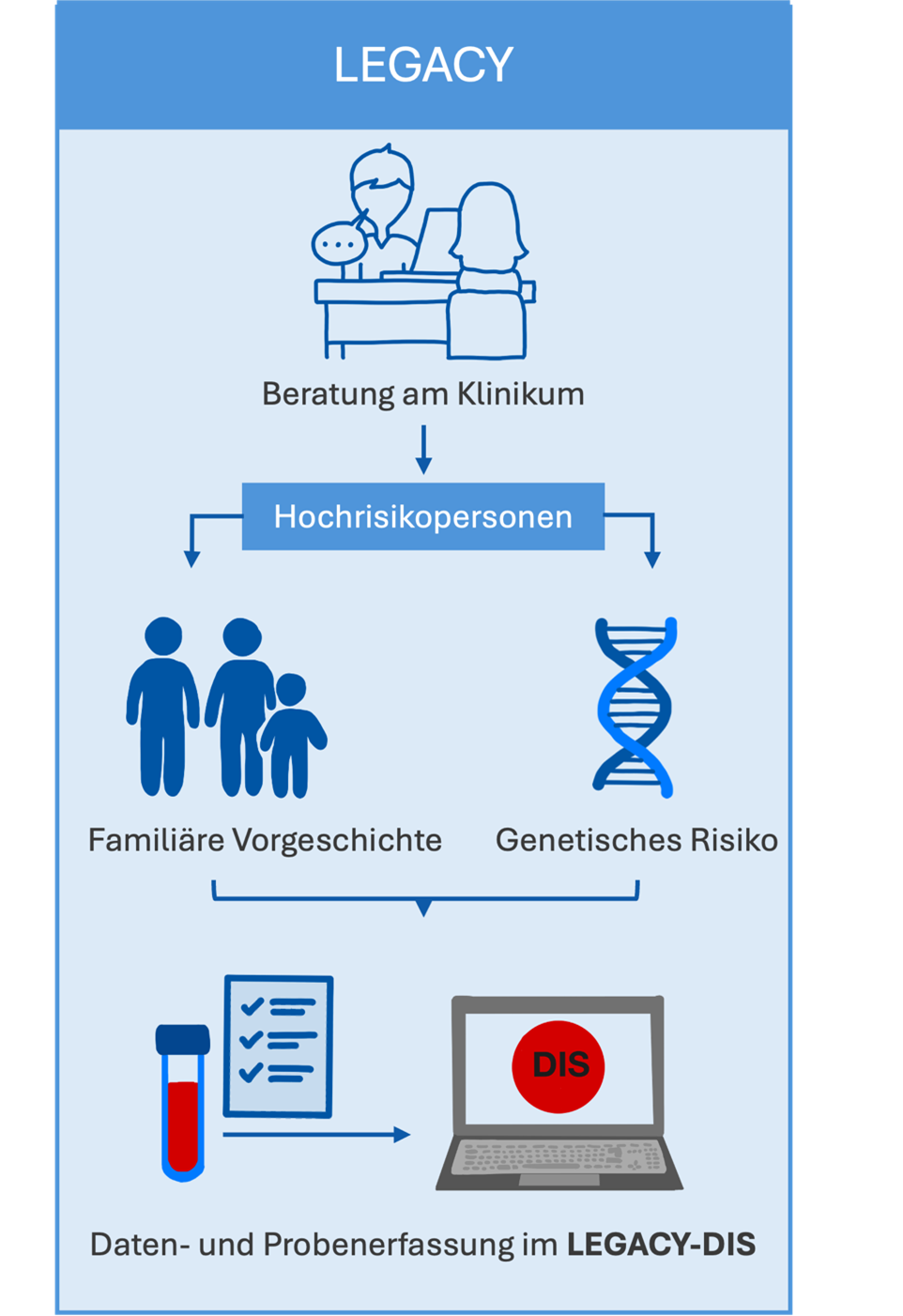
People who are found to be at increased risk during genetic counseling can be included in the study registry. Inclusion in the registry involves the following:
Completion of a questionnaire on health, lifestyle and family history
Blood sample as part of a routine blood draw for genetic and molecular analysis
Long-term medical documentation in a protected research database(LEGACY-DIS)
What else does LEGACY do?
In addition to the study registry for high-risk patients for the early detection of pancreatic cancer, LEGACY is actively researching hereditary pancreatic cancer for a better understanding of the disease and the development of new individualized therapies.
Stay informed
This website provides regular:
Current findings
Events and information evenings organized by the BZKF
Interesting facts about prevention, risk and new research
Contact persons:
Nina Haindl, nina.haindl@tum.deTUM Hospital Munich
Lisa Fricke, Lisa.Fricke@mri.tum.deTUM Hospital Munich
Further information:
Study on high-risk individuals with hereditary pancreatic cancer: CAPS-5 study