
Improving personalized therapy approaches to support innovative clinical trials
Pancreatic Cancer Study Group
Pancreatic cancer has one of the lowest five-year survival rates of all cancers. Many patients do not respond to the available treatments or quickly develop resistance. Intensive translational research is needed to develop new and improved therapeutic approaches that can increase survival rates and improve patients' quality of life. The BZKF-wide data integration platform is intended to contribute to the improvement of personalized therapeutic approaches and to map the heterogeneity of pancreatic cancer.

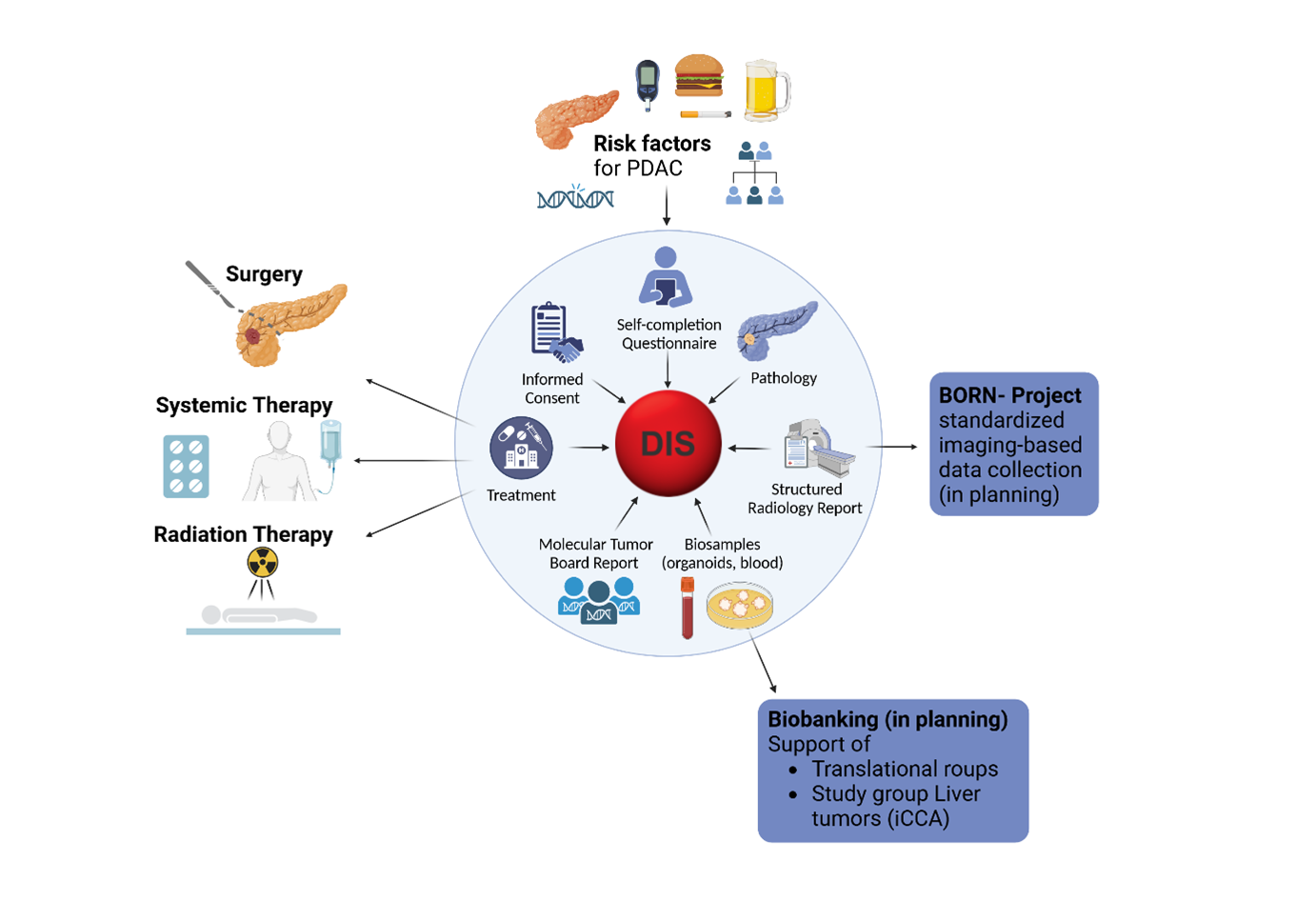
The Pancreatic Cancer Study Group of the BZKF was founded in 2021 and formed the Pancreatic Cancer Alliance Bavaria (PCAB) with all Bavarian university hospitals. The aim of the study group was and is to generate a comprehensive and prospective collective of newly diagnosed patients with pancreatic cancer for the design and implementation of innovative studies and the establishment of a suitable data integration system (DIS). A standardized questionnaire was established between the sites. This comprises epidemiological person-specific data (demographics, lifestyle, QoL) as well as clinical data that depicts the longitudinal course of the patient's disease (histology, therapy, radiology) and the analysis of genetic and phenotypic changes (MTB).
By June 2024, 872 patients had already been included and characterized across all sites.

In addition to mapping the clinical inter-individual heterogeneity of pancreatic cancer patients, a deeper understanding of the biological mechanisms that drive the growth and spread of pancreatic tumors is crucial. This may provide new targets for therapies, including the investigation of signaling pathways, the tumor microenvironment and immune responses. Initial approaches generated from the study group are already being translated into a companion research study on immunotherapy in pancreatic cancer. In addition to immunotherapy, advances in targeted therapies and personalized therapy approaches offer new hope. Furthermore, translational model systems for pancreatic cancer are being generated and further developed together with the lighthouse preclinical models. Further translational research projects are required to use these technologies effectively against pancreatic cancer.

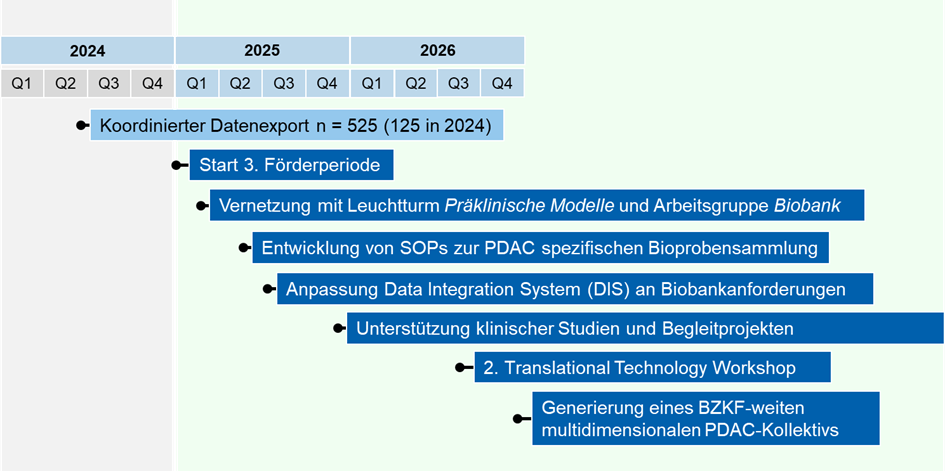
The main objective is to expand the content of the DIS to include biosamples in order to support prospective, translational and innovative clinical studies at BZKF level. For this purpose, a matrix for standardized site-specific biosample collection must be generated in order to generate complementary and focus-specific biomaterial. Based on this, SOPs for the respective biosample collection are to be created. The SOPs are to be harmonized on the basis of the Germany-wide DKTK biobank and together with the BZKF biobank working group. In a coordinated procedure, the ethical and legal permissions for operating a biobank (e.g. patient information and data protection framework concept) are to be drawn up and submitted to the respective location.

Support of internal BZKF projects (e.g. LEGACY (Prof. Reichert), alternative immune checkpoint inhibition in localized pancreatic cancer (Prof. Kunzmann)) and at national and international level using biosamples
Generation and further development of translational model systems for pancreatic cancer together with the Preclinical Models lighthouse
Improving the quality of life of patients

Further study groups
- Acute myeloid leukemia (AML)
- Cancer of Unknown Primary (CUP)
- Endocrine and neuroendocrine tumors
- Head and neck tumors
- Liver carcinoma
- Lung tumors
- Lymphoma
- Malignant melanoma
- Multiple myeloma
- Breast cancer
- Ovarian carcinoma
- Primary and secondary malignant brain tumors
- Prostate carcinoma
- R/R ALL
- Urothelial carcinoma
- Soft tissue sarcomas
- CNS tumors in children and adolescents