
Longitudinally harmonized and quality-assured biomaterial collection
Acute myeloid leukemia study group
Despite advances in therapy, the prognosis of patients with AML is poor. In this working group, we will conduct translational research projects to improve the prognosis of AML patients through longitudinal and prospective preservation of biomaterial in clinical trials and registries.

Despite innovations in the field of diagnostics and targeted therapy, the prognosis of older or relapsed AML patients in particular is often poor. The prospective preservation of biomaterial, especially for multi-omics analyses in the context of clinical studies and registries, represents a crucial pillar for future translational research projects to improve the prognosis of AML patients.

A key aim of the project is to collect samples from individual patients in the longitudinal course of their disease or therapy.
On the one hand, there is great interest in such longitudinal courses in all centers due to the high scientific value, on the other hand, complete sample sets are only available for very few patients. This aspect represents a considerable added value of BZKF biobanking, which creates optimal synergies between the participating centers. Regulatory aspects such as data protection, ethics and quality assurance must be taken into account. The aim is therefore to develop the necessary infrastructure and establish a longitudinal, harmonized and quality-assured biomaterial collection for AML at the BZKF.

P1: MRD monitoring
Establishment of a quantifiable method for determining MRD using flow cytometry in each center. Continuous recording of MRD.
P2: Mechanisms of therapy resistance and response
Analysis of the microbiome/metabolites in AML samples and correlation with immune and genomic profiles of immune cells.
P3: Inflammation and microenvironment
Analysis of the secretome and transcriptome in the course of therapy
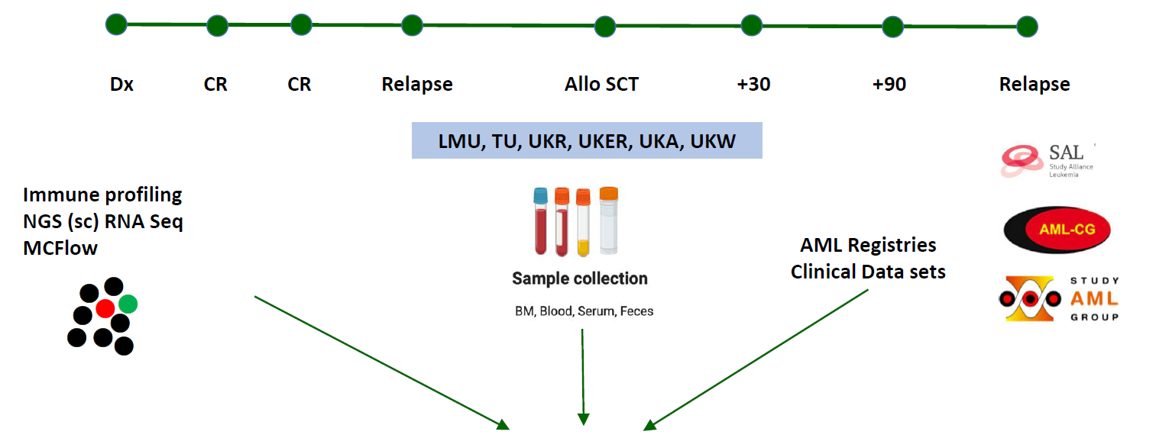

- Harmonization and prospective longitudinal biobanking at the six BZKF sites, taking into account the AML study groups (SAL, AMLCG, AMLSG)
- Establishment and joint use of innovative methods, e.g. spatial transcriptomics
- Overcoming therapy resistance by influencing the immune system, inflammasome and microbiome of patients

Further study groups
- Cancer of Unknown Primary (CUP)
- Endocrine and neuroendocrine tumors
- Head and neck tumors
- Liver carcinoma
- Lung tumors
- Lymphoma
- Malignant melanoma
- Multiple myeloma
- Breast cancer
- Ovarian carcinoma
- Pancreatic carcinoma
- Primary and secondary malignant brain tumors
- Prostate carcinoma
- R/R ALL
- Urothelial carcinoma
- Soft tissue sarcomas
- CNS tumors in children and adolescents